
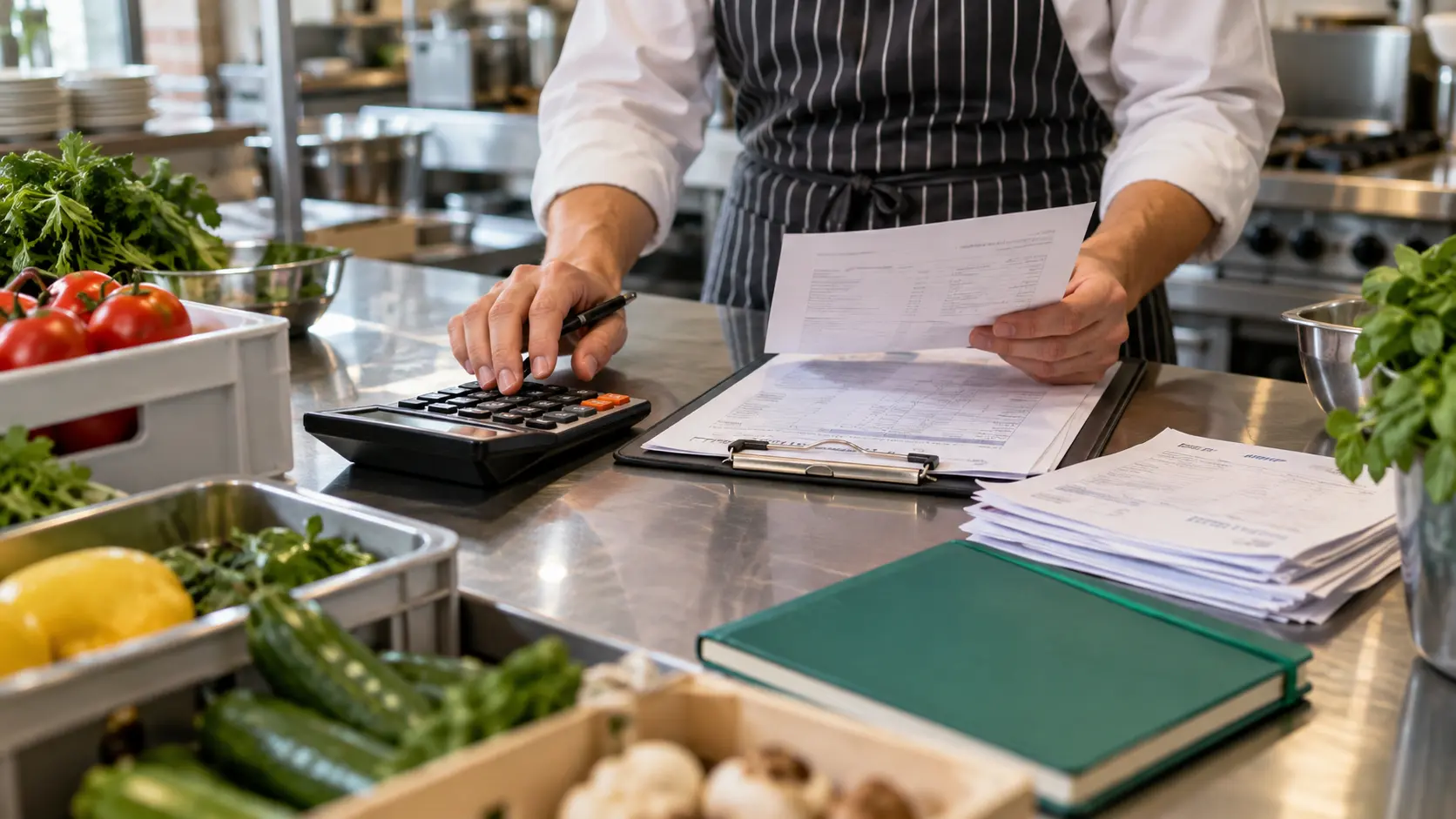
Food cost is the number that quietly decides whether a busy restaurant makes money. You can be full every night and still struggle if too much of each sale is going back out the door as ingredients.
The good news is that food cost percentage is simple to calculate and, once you track it, surprisingly controllable.
The basic formula
Food cost percentage is the cost of the food you used in a period, divided by your food sales for the same period, multiplied by 100.
To find the cost of food used, take your opening stock value, add your purchases, and subtract your closing stock value. For example: opening stock of 5,000, plus purchases of 12,000, minus closing stock of 4,500 gives a cost of food used of 12,500. If food sales for that period were 40,000, your food cost percentage is 12,500 divided by 40,000, times 100 — which is 31.25%.
The currency does not matter. The method works the same everywhere.
What does a good number look like?
There is no single right answer. It depends on your concept. A pizza or pasta restaurant with low-cost ingredients will typically run a lower percentage than a steakhouse or seafood restaurant. Fine dining may run higher on food but make it back on drinks and service.
Instead of chasing an industry average, set your own target from your menu costings, then watch the trend. A number that creeps up two or three points over a quarter is a warning sign worth acting on, whatever your starting point.
Why it matters more now
Costs are rising almost everywhere. Restaurant365’s 2026 mid-year report found that 87% of respondents reported food cost increases in the first half of 2026, and most expect prices to keep rising. The National Restaurant Association’s 2026 State of the Industry research points to the same pressure. When suppliers raise prices, the operators who already track food cost can respond in weeks rather than months.
Five ways to bring food cost down
Cost every dish properly, including garnishes and sauces, and update costings when supplier prices change.
Control portions with scoops, scales and plating photographs, so every chef serves the same dish.
Count stock regularly and investigate gaps. The difference between what you should have used and what you actually used is where theft, waste and over-portioning hide. Our guide to Inventory Management covers a practical counting system.
Rotate stock first in, first out and label everything, so less goes in the bin.
Engineer your menu: promote dishes with strong margins and rethink the ones that sell well but earn little.
Make it a team habit
Food cost is not only the chef’s problem. Waiters who know which dishes to recommend, and kitchen staff who understand portion control, all affect the number. Managers need to read the figures and act on them.
Our Financial Management course teaches managers to calculate and interpret food cost, labour cost and the other numbers that decide profit, with worked examples in several currencies. It is also part of Restaurant Manager Excellence, alongside stock control and leadership.
Calculate last month’s food cost percentage this week. Then calculate it again next month. The trend will tell you more than any average.
References
Restaurant365: 2026 State of the Restaurant Industry, Mid-Year Report. https://www.restaurant365.com/guides/2026-state-of-the-restaurant-industry-mid-year-report/ National Restaurant Association: 2026 State of the Restaurant Industry. https://restaurant.org/research-and-media/research/research-reports/state-of-the-industry/